Services

Air/Mist/Foam Drilling
Air Drilling is a technique used in areas where formations are Dry. That is there is very little on no influx of water (only very small amounts of water can be tolerated). High volumes of low-pressure air are used in place of onventional drilling fluids to circulate the well bore clean of cuttings. This method is also called Dust drilling due to the clouds of dust (finely ground formation cuttings) that are expelled away from the well bore by way of a return line usually called a Blooie Line.
The main advantages of Air Drilling are as follows:
- Increased Penetration Rates over conventional drilling fluid systems, in many cases 2 - 3 times higher.
- Ability to drill Lost Circulation zones and low-pressured formations, and maintain returns.
- Formation Damage is minimized since to the lack of hydrostatic pressure.
- Extended Bit Life since the compressed air cools the bit and transports the cuttings more quickly away from the drill bit’s cutting structure.
The disadvantages of Air Drilling are its inability to handle formation fluids or to contain sloughing shales. Air Drilling main application is in consolidated “hard rock” country applications where there is little to no fluid influx.
Mist Drilling is used when the rock formations begin to produce small amounts of water (10 to 100 bbls per hour) during air drilling operations. Air volumes are increased (usually 30% more than required in dust drilling). A Mist Pump is used to inject small quantities of a solution of water foaming agent and inhibitor. The foaming agent prevents cuttings form sticking together and the inhibitor is required to overcome the corrosive environment of the water-air mixture. A corrosion ring is usually run in the drill pipe to monitor the corrosion rate. The same advantages as for Air drilling also apply to Mist Drilling.
Foam Drilling is especially suitable for drilling large holes in formations that are prone to lost circulation. Foam is a gas liquid dispersion in which the liquid is the continuous phase and the gas is the discontinuous phase. The low density and high viscosity of foam at low shear rates make it extremely useful as a circulation medium in low pressure reservoirs. The consistency of foam is much like shaving cream. These properties minimize fluid loss to the formation and reduce required annular velocities yet provide high lifting capacity at minimum circulating pressures much better lifting capacity than that of a fluid. Foam can achieve bottom hole pressure equivalent to a circulating fluid weight in the range 0.2 to 0.8 s.g.
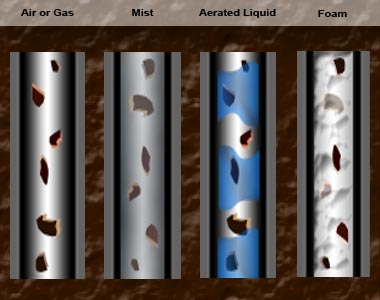
Quality "Q" = Percent gas volume to liquid volume
| Air / Gas | 100 Q |
| Mist | 99.5 - 99.99 Q |
| Foam | 30 - 99.5 Q |
| Nitrified Fluid | 0 - 30 Q (horizontal) |
| Nitrified Fluid | 0 - 40 Q (vertical) |
Drilling Fluid Systems
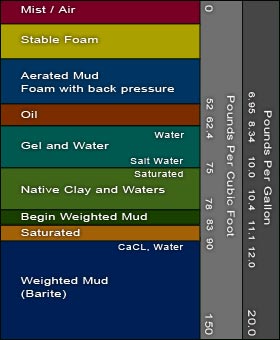
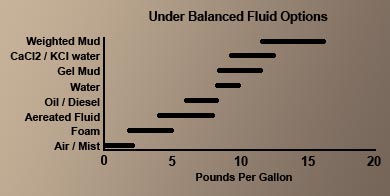
UBD Fluid Systems
Knowing when to use the appropriate fluid
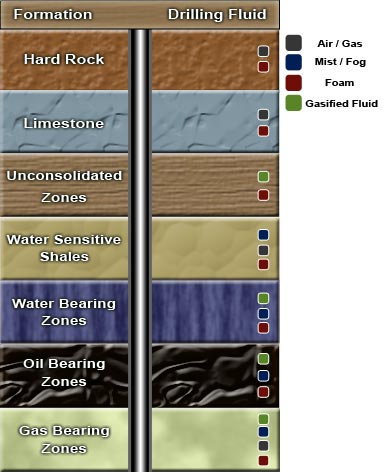
UBD Fluid Options